


Dental implant surgery, reline of the provisional denture (Case presentation) (20)
Male patient aged 62
Case history:
- During the previous treatment session his teeth were extracted due to severe uncontrolled periodontitis.
- He immediately received a provisional denture for the healing period of 4 months.
- Following suture removal and the resolution of the post-operative swelling our patient returned to the clinic for a reline of the provisional denture as it had gone loose and no longer had a seamless fit.
Second treatment phase, implant surgery (3 workdays)
Following 4 months’ healing time a CBCT (Cone beam computed tomography) scan was recorded to examine the residual bone mass prior to implant surgery. Our patient’s financial means only allowed for 4 implants to be installed in the mandible which would support a bar-retained denture whereas the upper jaw would accommodate a complete removable overdenture without implants. The upper jaw was perfectly suited for a stable and well-fitting complete overdenture owing to the vacuum effect induced between the palate and the denture. With the mandible there is no sufficiently large surface to induce an adequate vacuum effect. Owing to the constant movement of the tongue, masticatory muscles, mimic muscles a stable denture can only be achieved by means of implants.
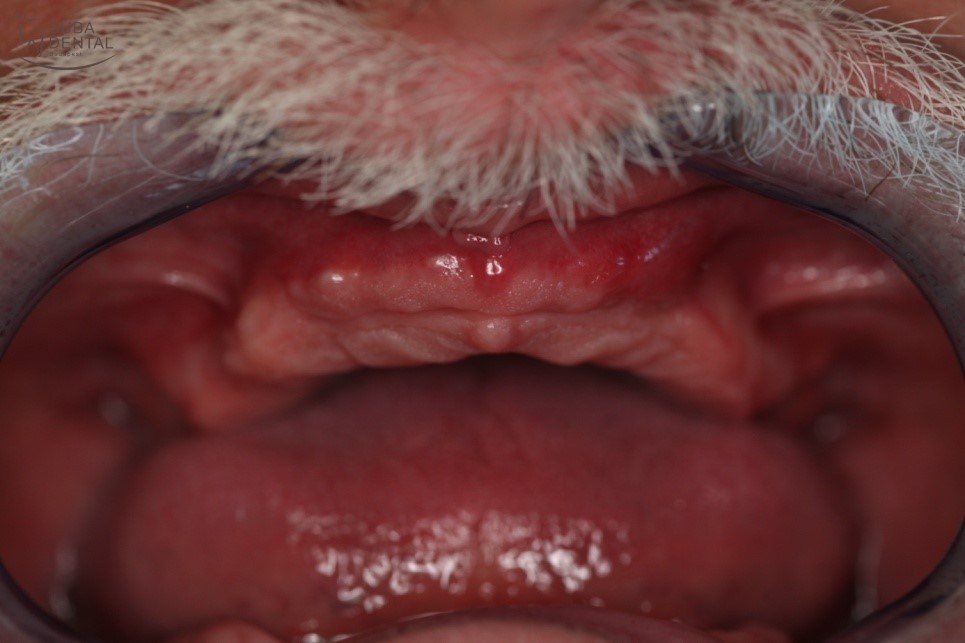
The upper jaw ridge following 4 months’ healing
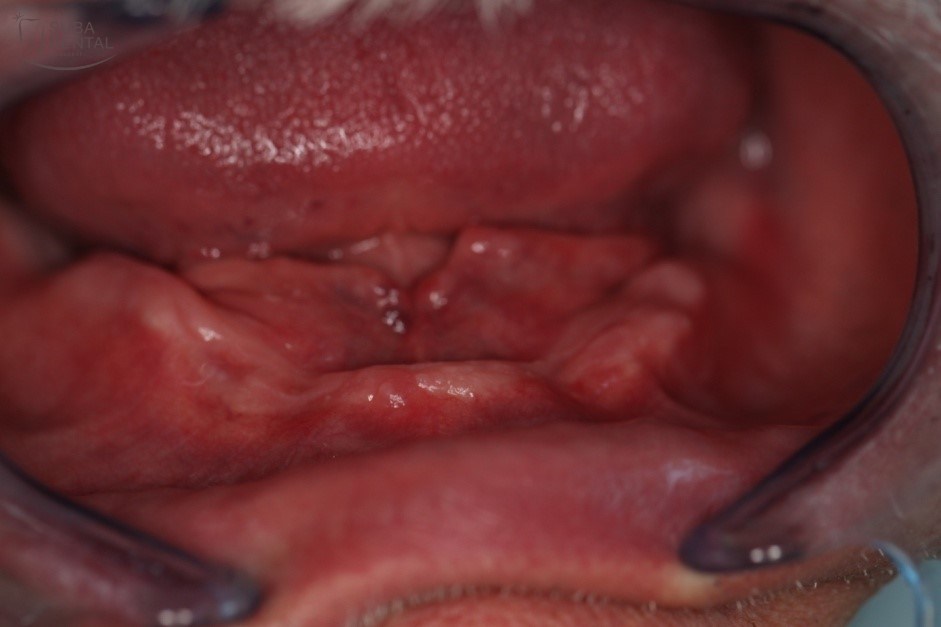
The lower jaw ridge following 4 months’ healing

CT scan in which the residual bone mass of the lower jaw bone can be examined in 3 dimensions, based on which the size and location of the implants can be assigned. The height of the bone in the lower region exceeded 15 mm and its width measured almost 7 mm, which qualify as very good parameters.
Following instalment the stability of the implants exceeded 30 Ncm, the exposed gum was therefore sealed with gingiva formers straight away. The provisional denture was relined as per the altered anatomic relations to ensure comfortable wear.
It is important to minimise the wearing time of provisional dentures following a bone graft and/or the placement of implants. Patients are advised only to wear the provisional dentures at work or at places where they are supposed to talk and smile. At home provisional dentures should be removed immediately. Please keep the denture and the mouth clean and see that the implanted/bone grafted area is not exposed to pressure and that the provisional denture does not “wiggle” on the implants.
Pressure exerted by the denture decreases blood circulation, hinders healing and may cause cracking, infection or, worst of all, the rejection of the implant, however well the implant was installed.

Follow-up radiograph following the placement of the 4 implants, with gingiva formers (aka. healing abutments)
The soft reline of the provisional denture:
Step 1: Roughening the surface of the dentures in contact with the gums with a drill to achieve the best possible adhesion of the reline material to the denture. In case of gingiva formers the denture has to be milled at the location of the gingiva formers to prevent it from wiggling and exposing the gingiva formers to pressure.


Step 2: Degreasing the surface of the dentures.

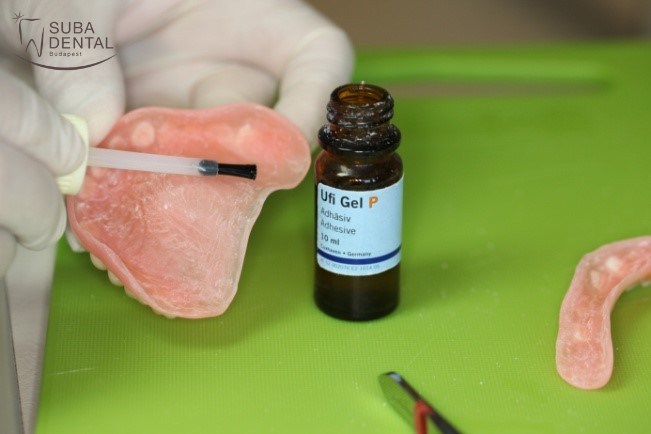
Step 3: Spreading glue on the roughened surfaces
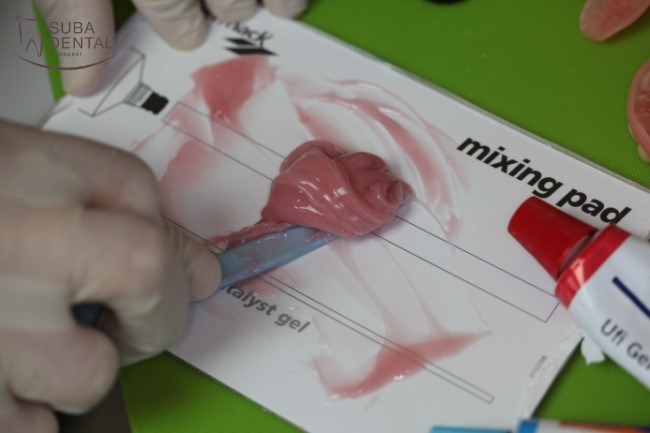
Step 4: The admeasurement, mixture and filling of the reline material into the denture
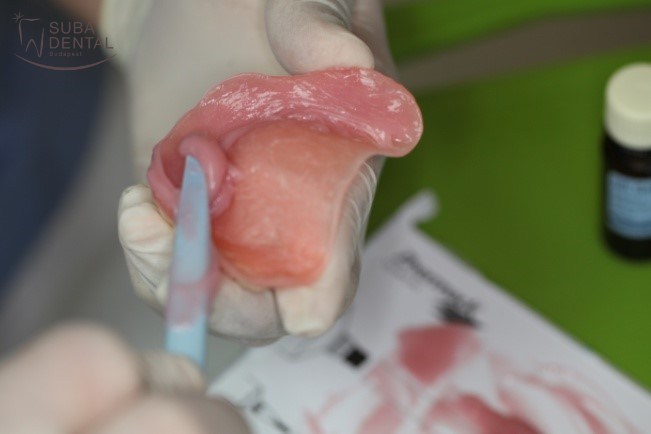
Step 5: The denture filled with reline material is placed inside the mouth and the patient is requested to bring the denture into occlusal position until the reline material bonds (approx. 5 minutes)

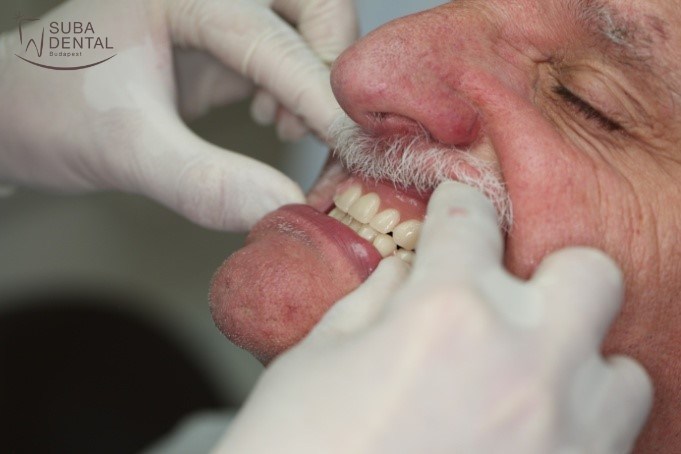
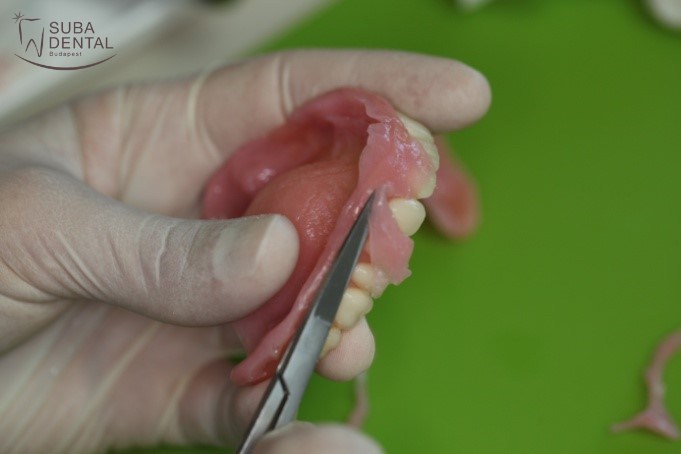
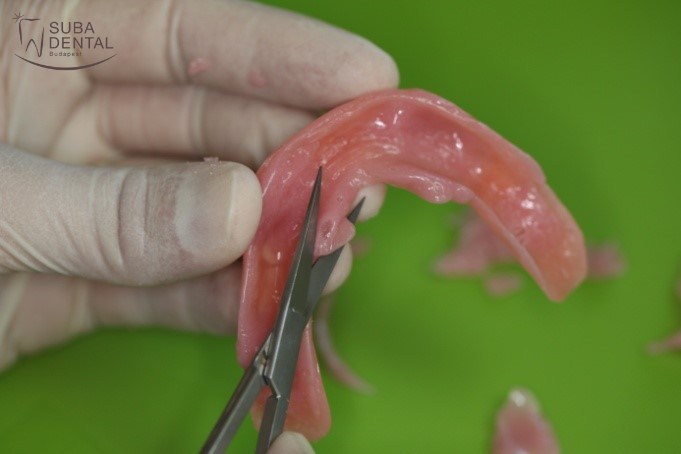
Step 6: With the reline material having bonded the dentures were removed from the mouth. It is readily seen in the pictures below that the material perfectly blends in with its environment without contrasting with the colour thereof. The denture is now fully in line with the altered anatomic relations, comfortable to wear and stable. The material having spilt over the edges of the denture can easily be trimmed away with a pair of scissors.
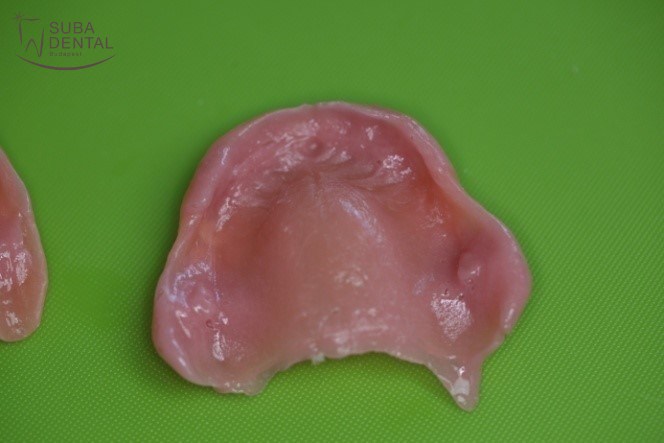
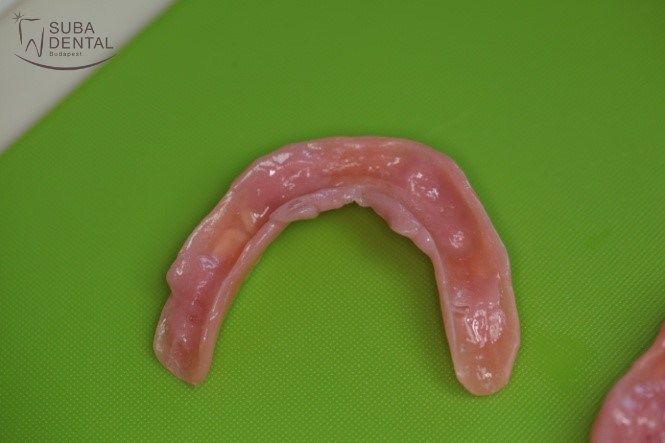
In the process of healing the anatomic relations constantly change. The reline made at the time of the operation will not provide the same stability several months later as it did initially. It is important to make sure that the denture does not wiggle on the implants and gingiva formers (healing abutments) as this puts the denture at a risk for injury, let alone the fact it adversely affects the healing process. The pressure exerted by a loose denture may dislodge the implant in a few weeks. In such cases patients are advised to wear the denture for as short a time as possible. If a new reline is feasible, that may help, but it means repairs and additional costs to be incurred by the patient. As a temporary fix, denture glues may also be considered.
Unfortunately there is a contingency that very big lobes need to be formed with a lot of bone drilled away, and hence the reline of the old denture becomes unfeasible following bone graft or implant surgery. In such instances a new provisional denture is recommended.
